Peer Reviewed Journal Iq Difference Between Male Female
Sex activity differences in homo intelligence accept long been a topic of argue among researchers and scholars. With the advent of the concept of g factor or general intelligence, many researchers have argued that there are no significant sexual activity differences in general intelligence,[one] [2] [three] although power in particular types of intelligence does appear to vary.[iii] [four]
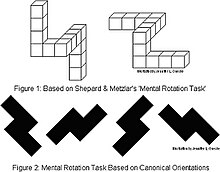
While some exam batteries show slightly greater intelligence in males, others show slightly greater intelligence in females.[3] [4] In item, studies take shown female subjects performing ameliorate on tasks related to verbal power,[2] and males performing better on tasks related to rotation of objects in space, often categorized equally spatial ability.[five]
Some research indicates that male advantages on some cognitive tests are minimized when decision-making for socioeconomic factors.[1] [4] It has also been hypothesized that there is slightly higher variability in male scores in certain areas compared to female scores, leading to males' being over-represented at the tiptop and bottom extremes of the distribution, though the evidence for this hypothesis is inconclusive.[6]
Research on general intelligence [edit]
Background [edit]
Chamorro-Premuzic et al. stated, "The one thousand factor, which is often used synonymously with full general intelligence, is a latent variable which emerges in a cistron analysis of diverse cognitive ('IQ') tests. They are not exactly the same affair. g is an indicator or mensurate of general intelligence; it's not general intelligence itself."[7]
All or nearly of the major tests usually used to measure intelligence have been constructed so that there are no overall score differences between males and females. Thus, at that place is little difference between the average IQ scores of men and women.[8] [9] Differences take been reported, however, in specific areas such equally mathematics and verbal measures.[4] [10] [5] Studies accept too found that the variability of male person scores is greater than that of female person scores.[10]
In favor of males or females in g factor [edit]
Enquiry, using the Wechsler Adult Intelligence Scale (WAIS Three and WAIS-R), that finds full general intelligence in favor of males indicates a very modest difference.[3] This is consistent beyond countries.[3] In the United States and Canada, the IQ points range from two to iii points in favor of males, while the points ascent to four points in favor of males in China and Japan.[3] By contrast, some inquiry finds greater reward for developed females.[4] For children in the United States and the netherlands, at that place are 1 to ii IQ point differences in favor of boys.[3] Other enquiry has found a slight advantage for girls on the residual verbal gene.[3]
A 2004 meta-assay by Richard Lynn and Paul Irwing published in 2005 plant that the mean IQ of men exceeded that of women by up to 5 points on the Raven's Progressive Matrices exam.[11] [12] He argued that there is a greater male advantage than nigh tests betoken, stating that because girls mature faster than boys, and that cerebral competence increases with physiological age, rather than with calendar historic period, the male-female difference is small or negative prior to puberty, but males have an advantage afterwards adolescence and this advantage continues into adulthood.[three]
In favor of no sex differences or inconclusive consensus [edit]
Most studies find either a very small deviation or no sex difference with regard to general intelligence.[iii] [thirteen] In 2000, researchers Roberto Colom and Francisco J. Abad conducted a large report of x,475 adults on 5 IQ tests taken from the Primary Mental Abilities and found negligible or no significant sex activity differences. The tests conducted were on vocabulary, spatial rotation, verbal fluency and inductive reasoning.[13]
The literature on sexual activity differences in intelligence has produced inconsistent results due to the type of testing used, and this has resulted in contend among researchers.[7] Garcia (2002) argues that there might be a small insignificant sex activity departure in intelligence in general (IQ) but this may not necessarily reflect a sexual practice difference in general intelligence or yard factor.[7] Although near researchers distinguish betwixt thousand and IQ, those that argued for greater male intelligence asserted that IQ and one thousand are synonymous (Lynn & Irwing 2004) and then the real division comes from defining IQ in relation to 1000 factor. In 2008, Lynn and Irwing proposed that since working retentiveness power correlates highest with g gene, researchers would accept no choice just to have greater male intelligence if differences on working retentiveness tasks are found. As a result, a neuroimaging written report published past Schmidt (2009) conducted an investigation into this proposal by measuring sex differences on an n-back working memory job. The results constitute no sex difference in working memory capacity, thus contradicting the position put forwards past Lynn and Irwing (2008) and more in line with those arguing for no sex differences in intelligence.[7] A 2009 meta analysis of Raven's Progressive Matrices information featuring large, international datasets revealed no sex activity differences in performance.[14]
A 2012 review by researchers Richard Eastward. Nisbett, Joshua Aronson, Clancy Blair, William Dickens, James Flynn, Diane F. Halpern and Eric Turkheimer discussed Arthur Jensen's 1998 studies on sexual practice differences in intelligence. Jensen's tests were significantly k-loaded simply were not prepare to get rid of any sexual practice differences (read differential particular functioning). They summarized his conclusions as he quoted, "No show was plant for sexual activity differences in the mean level of g or in the variability of g. Males, on average, excel on some factors; females on others." Jensen's conclusion that no overall sex differences existed for m has been reinforced by researchers who analyzed this issue with a bombardment of 42 mental ability tests and found no overall sex difference.[15]
Although most of the tests showed no sex activity difference, there were some that did. For case, they constitute female subjects performed meliorate on verbal abilities while males performed amend on visuospatial abilities.[15] For verbal fluency, females accept been specifically found to perform slightly better in vocabulary and reading comprehension and significantly higher in oral communication product and essay writing.[16] Males have been specifically found to perform meliorate on spatial visualization, spatial perception, and mental rotation.[16] Researchers had and so recommended that full general models such as fluid and crystallized intelligence be divided into verbal, perceptual and visuospatial domains of g; this is because, as this model is applied, females excel at exact and perceptual tasks while males excel on visuospatial tasks, thus evening out the sex differences on IQ tests.[15]
Variability [edit]
Some studies take identified the degree of IQ variance equally a difference betwixt males and females. Some researchers have argued that males tend to bear witness greater variability on many traits, a view which is termed the variability hypothesis; for example, having both highest and lowest scores on tests of cerebral abilities.[10] Other research has been published which contradicts this hypothesis, nevertheless, showing either equal variability between the sexes in some cultural contexts or else greater representation of females at the upper extreme of some measures of cognitive ability.[vi]
Feingold (1992) and Hedges and Nowell (1995) reported that, despite average sexual practice differences being modest and relatively stable over time, exam score variances of males were more often than not larger than those of females.[17] Feingold "establish that males were more than variable than females on tests of quantitative reasoning, spatial visualisation, spelling, and general knowledge. ... Hedges and Nowell go i step further and demonstrate that, with the exception of performance on tests of reading comprehension, perceptual speed, and associative memory, more males than females were observed among high-scoring individuals."[17]
In regards to variability in mathematics performance, a meta-analysis past Lindberg et al. (2010) found male-to-female variance ratios ranged from 0.88 to 1.34 across studies with an average of ane.07, indicating nigh equivalent male person and female variances.[eighteen] The authors note that greater male variability is not ubiquitous, and ratios less than 1.0 have been reported in some national and international data sets.[18] A review by Hyde et al. (2009) also evaluated the topic of greater male variability in mathematics performance.[xix] The review found that the gender gap among the highest performers has narrowed over time in the U.Southward., is not found among some ethnic groups and in some nations, and correlates with several measures of gender inequality.[19] The authors conclude that greater male variability in math performance is largely an antiquity of cultural factors equally opposed to innate biological sex differences.[19]
Brain and intelligence [edit]
Differences in brain physiology between sexes do not necessarily relate to differences in intellect. Although men take larger brains, men and women accept equal IQs.[20] For men, the gray matter volume in the frontal and parietal lobes correlates with IQ; for women, the gray matter volume in the frontal lobe and Broca's area (which is used in linguistic communication processing) correlates with IQ.[21] Women have greater cortical thickness, cortical complication and cortical surface area (controlling for torso size) which compensates for smaller brain size.[22] Meta-analysis and studies accept constitute that brain size explains 6–12% of variance among individual intelligence and cortical thickness explains five%.[23]
Although a meta-analysis of 148 samples from over 8000 participants reported a weak correlation between encephalon size and IQ,[23] no difference in IQ was observed comparing women to men, and the researchers ended that "it is non warranted to interpret encephalon size as an isomorphic proxy of man intelligence differences."[23] Brain book contributes little to IQ test performance. Outside of comparing intelligence levels of the sexes, brain size is merely i of numerous factors that influence intelligence, alongside white affair integrity, overall developmental stability, parieto-frontal neuronal networks, neuronal efficiency, and cortical gyrification. Encephalon structural integrity seems to exist more important as a biological basis.[23]
Mathematics performance [edit]

Girl scouts compete in the USS California Science Experience at Naval Surface Warfare Middle Corona Partitioning.
Across countries, males have performed meliorate on mathematics tests than females, merely the male person-female person deviation in math scores is related to gender inequality in social roles.[24] Some psychologists believe that many historical and electric current sex differences in mathematics performance may exist related to boys' higher likelihood of receiving math encouragement than girls. Parents were, and sometimes withal are, more probable to consider a son's mathematical accomplishment as being a natural skill while a daughter'due south mathematical achievement is more likely to be seen as something she studied hard for.[25] This difference in attitude may discourage girls and women from further involvement in mathematics-related subjects and careers.[25]
In a 2008 study paid for past the National Scientific discipline Foundation in the United States, researchers plant that girls perform as well as boys on standardized math tests. They attributed this to girls now taking as many advanced math courses as boys, dissimilar in the past.[26] [27]
There is also evidence that boys are over-represented among the very all-time and very worst performers on measures of mathematical ability and standardized measures of IQ.[26] Some research suggests that differences in mathematics course performance measures favor females.[28] A small performance departure in mathematics on the SAT[29] persists in favor of males, though the gap has shrunk from forty points (5.0%) in 1975[xxx] to 18 points (2.3%) in 2020.[31] However, the Sat is not a representative sample, given that it tests only higher-bound students, and more than women than men take attended higher since the 1990s.[32] Conversely, the international PISA exam provides representative samples. On the 2018 math PISA, in that location was no statistically meaning deviation between the performances of girls and boys in 39.v% of the 76 countries that participated. Meanwhile, boys outperformed girls in 32 countries (42.1%), while girls outperformed boys in fourteen (18.4%).[33] On average, boys performed 5 points (1%) higher than girls. Nonetheless, overall, the gender gap in math and science for boys and girls from like socio-economical backgrounds was not significant.[33]
A 2008 meta-analysis published in Science using data from over 7 million students found no statistically significant differences betwixt the mathematical capabilities of males and females.[34] A 2011 meta-analysis with 242 studies from 1990 to 2007 involving 1,286,350 people found no overall sex difference of performance in mathematics. The meta-analysis also found that although there were no overall differences, a small sexual activity difference that favored males in complex trouble solving was still present in high school. However, the authors note that boys proceed to take more physics courses than girls, which train complex solving abilities and may provide stronger training than pure mathematics.[18]
One line of inquiry has focused on the role that stereotype threat might play in mathematics performance differences between male and female exam-takers.[28] Systematic reviews and meta-analyses suggest that stereotype threat is implicated in operation differences on some mathematics tests, though the issue appears to vary considerable in unlike social contexts and for different test conditions.[35] [36] [37] [38] [39]
Reading and verbal skills [edit]
Studies have shown a female reward in reading and verbal skills.[two] On the international PISA reading exam, girls consistently outperform boys across all countries, and all differences are statistically significant. In the most recent PISA exam (2018), girls outperformed boys by most 30 points.[40] On boilerplate in OECD countries, 28% of boys did non obtain a reading proficiency level of two.
Studies take shown that girls spend more fourth dimension reading than boys and read more than for fun, likely contributing to the gap.[41]
Spatial power [edit]

A man playing a video game at the Nippon Media Arts Festival. Spatial abilities can be affected by experiences such as playing action video games, complicating inquiry on sex differences in spatial abilities.
Meta-studies show a male person advantage in mental rotation, assessing horizontality and verticality, and a male advantage for most aspects of spatial memory.[42] [43] [44] Women take an advantage for certain components of spatial memory. Whereas men evidence a selective reward for fine-grained metric positional reconstruction, where accented spatial coordinates are emphasized, women evidence an advantage in spatial location memory, which is the ability to accurately remember relative object positions (where objects are);[43] [45] [46] however, the reward in spatial location memory is small and inconsistent across studies.[46]
A proposed evolutionary hypothesis is that men and women evolved dissimilar mental abilities to adapt to their different roles, including labor-based roles, in guild.[46] For example, "ancestral women more oftentimes foraged for fruits, vegetables, and roots over large geographic regions."[46] The labor-based role explanation suggests that men may have evolved greater spatial abilities equally a issue of behaviors such every bit navigating during a hunt.[47]
Results from studies conducted in the physical environment are non conclusive about sexual activity differences. Various studies on the same chore show no differences. There are studies that prove no difference in finding ane'due south manner betwixt 2 places.[48]
Performance in mental rotation and similar spatial tasks is afflicted by gender expectations.[49] For example, studies show that being told before the test that men typically perform better, or that the task is linked with jobs similar aviation applied science typically associated with men versus jobs like fashion design typically associated with women, will negatively affect female person performance on spatial rotation and positively influence it when subjects are told the contrary.[50]
Playing computer or video games increases mental rotation ability, especially for females.[51] Playing action video games in particular benefits spatial abilities in females more than in males, up to a indicate where sex differences in spatial attention are eliminated.[51] Gender generally has an influence on preference of game genre. Action video games such as offset-person shooters, run a risk games, and sports games are mostly preferred by male players, while female players tend to prefer games such equally puzzle, card, and platform games.[52] [53]
The possibility of testosterone and other androgens as a cause of sex differences in psychology has been a subject of study, but results have been mixed. A meta-analysis of women who were exposed to unusually high levels of androgens in the womb due to built adrenal hyperplasia concluded that in that location is no testify of enhanced spatial ability amidst these individuals.[54] The meta-analysis speculates that average sexual practice differences in some spatial tasks could exist partially explained by androgen exposure at a different time of the life bridge, such as during mini-puberty, or past the different socialization males and females experience.[54] In add-on, a meta-analysis showed that, although female-to-male person transgender individuals who received testosterone therapy did better their spatial abilities, male person-to-female transgender individuals who took androgen-suppressants too showed an improvement or no deterioration of spatial skills.[55]
Sex differences in academics [edit]
A 2014 meta-analysis of sex differences in scholastic achievement published in the journal of Psychological Bulletin found females outperformed males in teacher-assigned school marks throughout elementary, junior/centre, high school and at both undergraduate and graduate university level.[56] The meta-assay washed by researchers Daniel Voyer and Susan D. Voyerwas from the University of New Brunswick drew from 97 years of 502 consequence sizes and 369 samples stemming from the yr 1914 to 2011, and establish that the magnitude of college female performance was not afflicted past year of publication, thereby contradicting contempo claims of "boy crunch" in schoolhouse achievement.[56]
A 2015 written report by researchers Gijsbert Stoet and David C. Geary from the journal of Intelligence reported that girl'due south overall instruction accomplishment is amend in 70 percent of all the 47–75 countries that participated in PISA.[57] The study consisting of 1.v million 15-year-olds establish college overall female achievement across reading, mathematics, and scientific discipline literacy and better performance across 70% of participating countries, including many with considerable gaps in economical and political equality, and they fell behind in only 4% of countries.[57] Stoet et al. said sexual activity differences in educational achievement are not reliably linked to gender equality.[57]
Historical perspectives [edit]
Prior to the 20th century, information technology was a commonly held view that men were intellectually superior to women.[58] [59] Early brain studies comparing mass and volumes between the sexes suggested that women were intellectually inferior considering they have smaller and lighter brains.[49] Author Helen H. Gardener publicly disputed this idea with William A. Hammond, onetime Surgeon Full general of the Usa Regular army.
In the 19th century, whether men and women had equal intelligence was seen by many as a prerequisite for the granting of suffrage.[60] Leta Hollingworth argued that women were not permitted to realize their full potential, as they were confined to the roles of child-rearing and housekeeping.
During the early 20th century, the scientific consensus shifted to the view that gender plays no role in intelligence.[61]
In his 1916 report of children'southward IQs, psychologist Lewis Terman concluded that "the intelligence of girls, at least up to 14 years, does not differ materially from that of boys". He did, however, find "rather marked" differences on a minority of tests. For example, he institute boys were "incomparably better" in arithmetical reasoning, while girls were "superior" at answering comprehension questions. He also proposed that discrimination, lack of opportunity, women's responsibilities in motherhood, or emotional factors may have deemed for the fact that few women had careers in intellectual fields.[62] [63]
See too [edit]
- Empathy
- Sex differences in emotional intelligence
- Sex differences in humans
- Emotional intelligence
- Sex differences in psychology
- Heritability of IQ
References [edit]
- ^ a b Plotnik R, Kouyoumdjian H (2013). Introduction to Psychology. Cengage Learning. pp. 282–283. ISBN978-1133939535.
- ^ a b c Hunt, Earl B. (2010). Human Intelligence. Cambridge Academy Printing. p. 389. ISBN978-1139495110.
- ^ a b c d due east f g h i j Hunt, Earl B. (2010). Human Intelligence. Cambridge University Press. pp. 378–379. ISBN978-1139495110.
- ^ a b c d e Mackintosh Due north (2011). IQ and Human Intelligence. OUP Oxford. pp. 362–363. ISBN978-0199585595.
- ^ a b Terry WS (2015). Learning and Memory: Basic Principles, Processes, and Procedures, Quaternary Edition. Psychology Press. p. 356. ISBN978-1317350873.
- ^ a b Bosson, Jennifer K.; Buckner, Camille E.; Vandello, Joseph A. (2020). The Psychology of Sexual activity and Gender. New York: SAGE Publications. pp. 250–251. ISBN978-1544394015.
- ^ a b c d Chamorro-Premuzic, Tomas; Stumm, Sophie von; Furnham, Adrian (2015). The Wiley-Blackwell Handbook of Private Differences. John Wiley & Sons. pp. 346, 363. ISBN978-1119050308.
- ^ Worell J (2001). Encyclopedia of Women and Gender, Two-Volume Set: Sex Similarities and Differences and the Impact of Social club on Gender. Bookish Press. p. 964. ISBN0122272455.
- ^ Kid D (2007). Psychology and the teacher. Continuum. p. 305. ISBN978-0826487155.
- ^ a b c Chrisler JC, McCreary DR (2010). Handbook of Gender Research in Psychology: Volume i: Gender Inquiry in General and Experimental Psychology. Springer Science & Concern Media. p. 302. ISBN978-1441914651.
- ^ Irwing, Paul; Lynn, Richard (2005). "Sexual practice differences in means and variability on the progressive matrices in university students: A meta-analysis". British Journal of Psychology. 96 (4): 505–24. doi:10.1348/000712605X53542. PMID 16248939. S2CID 14005582.
- ^ Lynn, Richard; Irwing, Paul (2004). "Sex differences on the progressive matrices: A meta-analysis". Intelligence. 32 (five): 481–498. doi:ten.1016/j.intell.2004.06.008.
- ^ a b The Scientific Study of Full general Intelligence. 2003. doi:10.1016/B978-0-08-043793-four.X5033-8. ISBN9780080437934.
- ^ Brouwers, Symen A.; Van de Vijver, Fons J.R.; Van Hemert, Dianne A. (September 2009). "Variation in Raven's Progressive Matrices scores across fourth dimension and place" (PDF). Learning and Individual Differences. nineteen (iii): 330–338. doi:ten.1016/j.lindif.2008.10.006.
- ^ a b c Nisbett, Richard East.; Aronson, Joshua; Blair, Clancy; Dickens, William; Flynn, James; Halpern, Diane F.; Turkheimer, Eric (February 2012). "Intelligence: New findings and theoretical developments". American Psychologist. 67 (two): 130–159. doi:x.1037/a0026699. PMID 22233090.
- ^ a b Hyde, Janet Shibley (2006). "Women in Scientific discipline and Mathematics: Gender Similarities in Abilities and Sociocultural Forces". Biological, Social, and Organizational Components of Success for Women in Academic Science and Engineering: Report of a Workshop. National Academies Press. pp. 127–137. ISBN978-0-309-10041-0.
- ^ a b Archer, John; Lloyd, Barbara (2002-07-eleven). Sex activity and Gender . Cambridge University Printing. pp. 187–188. ISBN9780521635332.
- ^ a b c Lindberg, Sara M.; Hyde, Janet Shibley; Petersen, Jennifer L.; Linn, Marcia C. (2010). "New trends in gender and mathematics operation: A meta-assay". Psychological Bulletin. 136 (6): 1123–1135. doi:10.1037/a0021276. PMC3057475. PMID 21038941.
- ^ a b c Hyde, Janet South.; Mertz, Janet E. (2009-06-02). "Gender, culture, and mathematics performance". Proceedings of the National University of Sciences of the U.s.. 106 (22): 8801–8807. Bibcode:2009PNAS..106.8801H. doi:x.1073/pnas.0901265106. ISSN 0027-8424. PMC2689999. PMID 19487665.
- ^ Kalat JW (2012). Biological Psychology. Cengage Learning. pp. 118, 120. ISBN978-1111831004.
- ^ Garrett B, Hough M (2017). Brain & Beliefs: An Introduction to Behavioral Neuroscience. Sage Publications. p. 118. ISBN978-1506349190.
- ^ Sex difference in the human brain, their underpinnings and implications. Elsevier. 2010. pp. 6–7. ISBN9780444536310.
- ^ a b c d Pietschnig, Jakob; Penke, Lars; Wicherts, Jelte M.; Zeiler, Michael; Voracek, Martin (2015-ten-01). "Meta-analysis of associations between human being encephalon book and intelligence differences: How stiff are they and what do they mean?". Neuroscience & Biobehavioral Reviews. 57: 411–432. doi:ten.1016/j.neubiorev.2015.09.017. PMID 26449760. S2CID 23180321.
- ^ Sternberg RJ, Kaufman SB (2011). The Cambridge Handbook of Intelligence. Cambridge University Printing. p. 877. ISBN978-1111831004.
- ^ a b Wood, Samuel; Wood, Ellen; Boyd Denise (2004). "World of Psychology, The (Fifth Edition)", Allyn & Bacon ISBN 0-205-36137-4.[ page needed ]
- ^ a b Davis, Andrew S. (2010). Handbook of Pediatric Neuropsychology. Springer Publishing Company. p. 1089. ISBN978-0-82-615737-9.
- ^ Crooks RL, Baur K (2016). Our Sexuality. Cengage Learning. p. 125. ISBN978-1305887428.
- ^ a b Ann M. Gallagher, James C. Kaufman, Gender differences in mathematics: an integrative psychological approach, Cambridge Academy Press, 2005, ISBN 0-521-82605-5, ISBN 978-0-521-82605-1[ page needed ]
- ^ "Gender differences in mathematics performance", p.196. OECD 2015.
- ^ Burton, Nancy W.; Lewis, Charles; Robertson, Nancy (December 1988). "SEX DIFFERENCES IN Saturday® SCORES". ETS Research Study Series. 1988 (ii): i–23. doi:10.1002/j.2330-8516.1988.tb00314.x. ISSN 2330-8516.
- ^ "2021 Sabbatum Suite of Assessments Program Results – The College Lath". College Lath Program Results. 2021-09-08. Retrieved 2021-09-16 .
- ^ Stoet, Gijsbert; Geary, David C. (2020-06-23). "Gender differences in the pathways to higher education". Proceedings of the National University of Sciences. 117 (25): 14073–14076. doi:10.1073/pnas.2002861117. PMC7322061. PMID 32513710.
- ^ a b "Dwelling". www.oecd-ilibrary.org . Retrieved 2021-09-16 .
- ^ "Study: No gender differences in math operation". news.wisc.edu . Retrieved 2021-09-16 .
- ^ Nguyen HH, Ryan AM (Nov 2008). "Does stereotype threat touch on test performance of minorities and women? A meta-analysis of experimental evidence". The Journal of Applied Psychology. 93 (6): 1314–34. doi:10.1037/a0012702. PMID 19025250.
- ^ Walton, Gregory M.; Spencer, Steven J. (2009-09-01). "Latent Power: Grades and Test Scores Systematically Underestimate the Intellectual Ability of Negatively Stereotyped Students". Psychological Science. 20 (ix): 1132–1139. doi:ten.1111/j.1467-9280.2009.02417.ten. ISSN 0956-7976. PMID 19656335. S2CID 25810191.
- ^ Picho, Katherine; Rodriguez, Ariel; Finnie, Lauren (May 2013). "Exploring the Moderating Part of Context on the Mathematics Functioning of Females Under Stereotype Threat: A Meta-Analysis". The Journal of Social Psychology. 153 (three): 299–333. doi:10.1080/00224545.2012.737380. PMID 23724702. S2CID 45950675.
- ^ Pennington, Charlotte R. (2016-01-eleven). "Twenty Years of Stereotype Threat Inquiry: A Review of Psychological Mediators". PLOS One.
- ^ Liu, Songqi; Liu, Pei; Wang, Mo; Zhang, Baoshan (July 2020). "Effectiveness of Stereotype Threat Interventions: A Meta-Analytic Review". Periodical of Applied Psychology. 106 (vi): 921–949. doi:10.1037/apl0000770. PMID 32772526. S2CID 221098319.
- ^ "PISA 2018 Data". PISA 2018 Results (Book II). PISA. 2019-12-03. doi:x.1787/fb6da32e-en. ISBN9789264893528. ISSN 1996-3777. S2CID 241738948.
- ^ Hughes-Hassell, Sandra; Rodge, Pradnya (2007). "The Leisure Reading Habits of Urban Adolescents". Journal of Adolescent & Adult Literacy. 51 (1): 22–33. doi:10.1598/JAAL.51.ane.iii. ISSN 1081-3004. JSTOR 40015543.
- ^ Fernandez-Baizan, C.; Arias, J.50.; Mendez, M. (February 2019). "Spatial retentiveness in immature adults: Gender differences in egocentric and allocentric performance". Behavioural Encephalon Enquiry. 359: 694–700. doi:10.1016/j.bbr.2018.09.017. hdl:10651/49938. PMID 30273614. S2CID 52879258.
- ^ a b Voyer, Daniel; Voyer, Susan D.; Saint-Aubin, Jean (Apr 2017). "Sex activity differences in visual-spatial working retention: A meta-analysis". Psychonomic Bulletin & Review. 24 (ii): 307–334. doi:10.3758/s13423-016-1085-7. PMID 27357955.
All the tasks produced a male reward, except for retention for location, where a female advantage emerged.
- ^ Chrisler, Joan C; Donald R. McCreary (2010). Handbook of Gender Enquiry in Psychology. Springer. p. 265. ISBN9781441914644.
- ^ Becker, Jill B.; Berkley, Karen J.; Geary, Nori; Hampson, Elizabeth; Herman, James P.; Young, Elizabeth (2007). Sexual activity Differences in the Brain: From Genes to Beliefs. Oxford University Press. p. 316. ISBN978-0198042556.
- ^ a b c d Bosson, Jennifer Thousand.; Buckner, Camille E.; Vandello, Joseph A. (2021). The Psychology of Sex activity and Gender. SAGE Publications. p. 271. ISBN978-1544394039.
- ^ Weiten, Wayne (2016). Psychology: Themes and Variations. Cengage Learning. p. 27. ISBN978-1-30-585612-7.
- ^ Devlin, Ann Sloan, Mind and maze: spatial cognition and environmental behavior, Praeger, 2001, ISBN 0-275-96784-0, ISBN 978-0-275-96784-0[ page needed ]
- ^ a b Fine C (2005). Delusions of Gender: The Real Science Behind Sex Differences. Icon Books. p. 96. ISBN1848313969.
- ^ Newcombe, Nora Due south. (2007). "Taking Science Seriously: Direct Thinking About Spatial Sex Differences". Why aren't more women in science?: Top researchers debate the prove. pp. 69–77. doi:10.1037/11546-006. ISBN978-one-59147-485-ii.
- ^ a b Freiman, Viktor; Tassell, Janet Lynne (2018). Creativity and Applied science in Mathematics Instruction. Springer. p. 310. ISBN978-3-31-972381-5.
- ^ Quandt, Thorsten; Kröger, Sonja (2013). Multiplayer: The Social Aspects of Digital Gaming. Routledge. p. 36. ISBN978-ane-thirteen-409219-two.
- ^ Donsbach, Wolfgang (2015). The Curtailed Encyclopedia of Communication. John Wiley & Sons. pp. 104–105. ISBN978-ane-11-878923-0.
- ^ a b Collaer, Marcia L.; Hines, Melissa (February 2020). "No Show for Enhancement of Spatial Ability with Elevated Prenatal Androgen Exposure in Congenital Adrenal Hyperplasia: A Meta-Assay". Archives of Sexual Behavior. 49 (2): 395–411. doi:10.1007/s10508-020-01645-vii. PMID 32052211. S2CID 211101661.
- ^ Karalexi, Maria A.; Georgakis, Marios K.; Dimitriou, Nikolaos G.; Vichos, Theodoros; Katsimpris, Andreas; Petridou, Eleni Th.; Papadopoulos, Fotios C. (September 2020). "Gender-affirming hormone treatment and cerebral function in transgender immature adults: a systematic review and meta-analysis". Psychoneuroendocrinology. 119: 104721. doi:10.1016/j.psyneuen.2020.104721. PMID 32512250. S2CID 219123865.
- ^ a b Voyeur, Daniel (2014). "Gender Differences in Scholastic Achievement: A Meta-Analysis" (PDF). Psychological Message. 140 (4): 1174–1204. doi:10.1037/a0036620. PMID 24773502.
- ^ a b c Stoet, Gijsbert; Geary, David C. (1 January 2015). "Sex differences in bookish achievement are not related to political, economic, or social equality". Intelligence. 48: 137–151. doi:ten.1016/j.intell.2014.11.006.
- ^ Lips, Hilary K. (1997). Sexual activity & Gender: An Introduction (third ed.). Mount View, Calif.: Mayfield. p. 40. ISBN978-1559346306.
- ^ Denmark, Florence L.; Paludi, Michele A. (2008). Psychology of Women: A Handbook of Issues and Theories (2nd ed.). Westport, Conn.: Praeger. pp. seven–xi. ISBN978-0275991623.
- ^ Margarete Grandner, Austrian women in the nineteenth and twentieth centuries: cross-disciplinary perspectives, Berghahn Books, 1996, ISBN one-57181-045-5, ISBN 978-1-57181-045-8
- ^ Burt, C. L.; Moore, R. C. (1912). "The mental differences between the sexes". Journal of Experimental Education. 1 (273–284): 355–388.
- ^ Terman, Lewis G. (1916). The measurement of intelligence: an explanation of and a complete guide for the use of the Stanford revision and extension of the Binet-Simon intelligence scale. Boston: Houghton Mifflin. pp. 68–72. OCLC 186102.
- ^ Dennis Westward (1972). Historical readings in developmental psychology . Appleton-Century-Crofts. p. 214. ISBN9780390262998.
hawthornefuldebou.blogspot.com
Source: https://en.wikipedia.org/wiki/Sex_differences_in_intelligence

Post a Comment for "Peer Reviewed Journal Iq Difference Between Male Female"